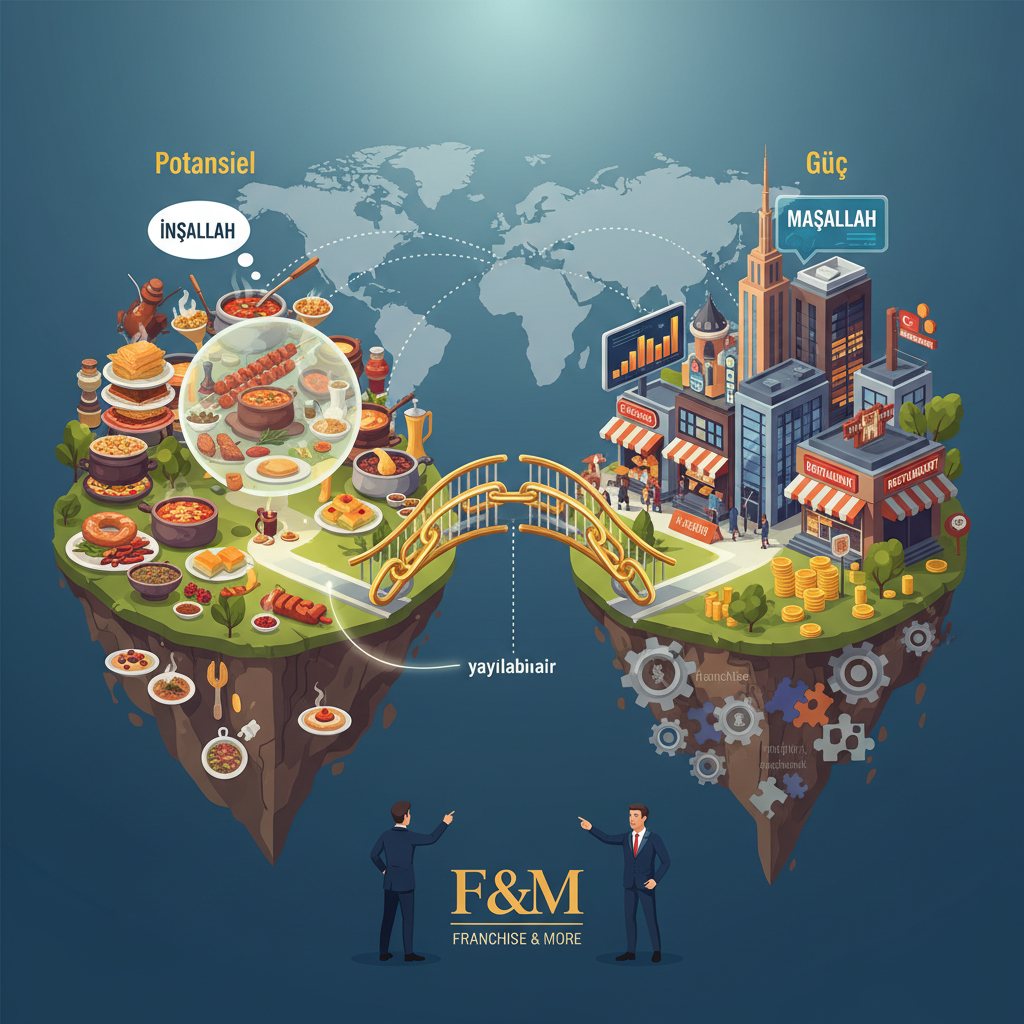
THE STRENGTH AND POTENTIAL OF TURKISH CUISINE
I recently attended two gastronomy-themed events in Istanbul. In October, Gastroshow brought together distinguished representatives of Turkish cuisine, and the global standing of Turkish cuisine was discussed. In November, Gastromasa hosted renowned chefs from international cuisines, and the future direction of world cuisine was discussed.
The messages conveyed at both events essentially boiled down to this: Turkish cuisine has not yet reached the place it deserves in the world. The world of gastronomy has shifted from simply feeding people to creating experiences. It’s impossible not to participate in both.
Palace Cuisine
Turkish cuisine is the legacy of the Ottoman Empire. Different geographies and cultures from three continents nourished the palace, and chefs competed to feed thousands and win the favor of a single person. In such an environment, a rich culinary culture naturally emerges. Indeed, Chinese, Italian, Greek, French, and British cuisines are also the legacy of empires that once ruled vast territories.
Culinary culture is fluid. The Ottomans adopted olive oil dishes from Byzantium and rice pilaf from Iran. The British national drink, tea, came from China, and their favorite spice, curry, from India. French cuisine was revitalized thanks to the chefs of the Medici family, who arrived from Italy as queens. Europe was introduced to coffee during the Siege of Vienna.
The empire of this era is America, and its cuisine is, in their own words, a true “melting pot.” Pizza and pasta from Italy, tacos and burritos from Mexico, hamburgers and hot dogs from Germany, sushi from Japan, french fries from France, donuts from the Netherlands, cheesecake from Greece, fried chicken from Africa, steak from Argentina, and who knows what else from where. Palaces kept the fine cuisine to themselves; Americans simplified it, turned it into chains, and spread it across the world.
Culinary culture was once passed down from master to apprentice through intuition and the touch of the hand. The French developed recipes, measurements, and cooking techniques, passing them on through education. Americans established procedures and are spreading them through franchising.
Culinary Schools
Chefs from the traditional school, who learn from a master, never stray from authentic recipes. Chefs from the innovative school, who learn in school or from books, think freely and interpret dishes in their own way. Traditionalists open neighborhood eateries; innovators open chef-driven restaurants. Traditionalists view innovators as degenerate; innovators find traditionalists too conservative.
The new school consists of fast-food chefs. They prepare popular dishes with limited variety, using pre-made ingredients, modern equipment, and without requiring skill, serving them quickly using disposable utensils. Fast-food chefs don’t distinguish between authentic and modern— they simply make whatever they’re selling. They sell künefe, put ice cream on semolina halva, squeeze cream into lokma, and if that doesn’t work, they pour tahini over churros and sell them. Fast food operators pay no heed to the traditionalist-innovator clash; they adapt to their customers and spread across the world.
The Power of the Kitchen
In his opening speech at Gastroshow, UFRAD President Prof. Mustafa Aydın approached the traditionalist-innovator debate from a different perspective. By asking, “The potential of Turkish cuisine is great, but what is its power?” he emphasized the importance of market share. I wanted to share this approach—which I particularly appreciate from an engineer’s perspective—with you.
The concepts we use in daily life—such as “positive energy,” “strong wine,” “strong relationship,” and “the potential of a business”—have a different meaning in physics, and their formula is well-defined. For example, in electricity, potential is the 220-volt voltage at the outlet, while power is the product of the amperes drawn by the motor and the voltage. In mechanics, the potential of a mass is proportional to how high it is positioned, while its power is proportional to its speed when it falls to the ground. Potential is static, power is dynamic; it is power that does the work.
The President clarified the distinction between “the kitchen’s potential and power” using the formula from physics. The kitchen’s potential lies in its flavor, variety, nutritional value, and such characteristics, while its power lies in numerical quantities like how many locations it’s served in, how many people eat there, and how much money is paid.
For example, a very delicious dish may have great potential. If it’s sold only in its own restaurant, its power is 1. If it expands into a chain and opens 100 locations, its power becomes 100.
American cuisine isn’t as diverse as Turkish cuisine, but it’s very powerful; the annual revenue of restaurants in the U.S. is 1 trillion dollars. There are 90,000 hamburger joints and 80,000 pizzerias, with chains holding a 40% market share. The largest hamburger chain has over 40,000 locations worldwide and revenue exceeding 100 billion dollars. The largest pizza chain has over 20,000 locations worldwide and a total revenue of over 25 billion dollars. The total global revenue of American food chains is close to 1 trillion dollars. That is the power.
The Power of Döner
The only product of ours competing with Americans in the global market is döner. It originated in Turkey in the 19th century, became the most popular fast food item in Germany in the 21st century, and then spread rapidly in every country it entered. In Turkey, 30,000 döner shops generate 10 billion dollars in revenue, while worldwide, 120,000 döner shops generate 50 billion dollars in revenue.
The success of döner does not stem from traditionalists’ authentic recipes; Turkey mostly eats chicken döner, while the world eats exclusively German-style döner. Innovators’ recipes—such as vegetable-based or cheddar-sauce versions—did not catch on; the taste of döner was defined by the streets. The success wasn’t driven by fast-food chains’ franchise techniques either; the market share of chains is very low domestically and nonexistent abroad. The government didn’t contribute either; it only introduced standards for döner after Germany did.
This success of the döner, achieved without a team, a coach, or government support, resembles that of the wrestler Koca Yusuf, who in 1898–99 defeated all his rivals in Europe and America. This potential exists in Turkish cuisine; from dolma to börek, from kebab to pide, many more Koca Yusufs could emerge—but perhaps only once in a century.
The Power of Unity
For Turkish cuisine to spread across the world not on its own like döner, but through the ingenuity of brands like the hamburger, it must work not like Koca Yusuf, but like a national team. For this, everyone must do their part: traditionalists must secure geographical indications, innovators must adapt to different cultures, fast-food operators must standardize, and the government must encourage local concepts. If we don’t collaborate, everyone will take the easy way out: traditionalists will retreat to neighborhood eateries, innovators will shut themselves away in chef-driven restaurants, and fast-food operators will sell burgers and pizza. For years, we’ve talked endlessly about Turkish cuisine’s high potential, but we can’t see its true power.
Turkey has learned the franchise business over 40 years. There are 3,000 chains in the U.S., and 2,000 here. We’re numerous but not strong; on average, chains have 250 branches in the U.S. and 25 here. For fast-food chains to expand globally, they must first grow and become stronger. As UFRAD, we support Turkish chains expanding globally. We also expect our government to introduce regulations that encourage institutionalization within the franchise system.